Réunion
Caméras événementielles et modèles neuromorphiques – Applications en robotique (Event-Based Vision and Neuromorphic Computing for Robotics)
Axes scientifiques :
- Audio, Vision et Perception
GdRs impliqués :
Organisateurs :
Nous vous rappelons que, afin de garantir l'accès de tous les inscrits aux salles de réunion, l'inscription aux réunions est gratuite mais obligatoire.
Inscriptions
39 personnes membres du GdR IASIS, et 66 personnes non membres du GdR, sont inscrits à cette réunion.
Capacité de la salle : 105 personnes. 0 Places restantes
Inscriptions closes pour cette journée
Annonce
Les inscriptions réalisées entre le 17 juin et le 13 septembre n’ont pas été prises en compte; il est nécessaire de vous inscrire à nouveau à la journée.
Les demandes de prise en charge de mission par le GdR, sont acceptées jusqu’au 22 septembre.
Changement de lieu du 06/10, à partir de 13h (pour ceux qui sont restés) : UTC Paris, 62 boulevard de Sébastopol, Paris 3e, et visio [lien supprimé]
Cette journée est co-organisée avec le GdR Robotique.
Objectifs de la journée / Scope and objectives
Les caméras événementielles constituent une alternative aux capteurs d’imagerie conventionnels en produisant une information visuelle asynchrone, parcimonieuse et dotée d’une très haute dynamique et résolution temporelle. Ces propriétés les rendent particulièrement adaptées aux contextes robotiques caractérisés par des dynamiques rapides, des contraintes temps réel et des limitations en calcul et en consommation énergétique.
En parallèle, le développement de représentations et de traitements adaptés aux données événementielles, avec en première ligne des modèles d’apprentissage dédiés (à base de réseaux de neurones convolutifs, d’architectures de type Transformers et réseaux de neurones à impulsions – Spiking Neural Networks, SNN), permet d’exploiter efficacement ces nouvelles modalités de perception. Les SNN, en particulier, présentent un intérêt marqué pour l’embarqué du fait de leur fonctionnement événementiel et de leur adéquation avec des architectures matérielles neuromorphiques, offrant des perspectives prometteuses en termes de latence, de sobriété énergétique et de calcul en ligne.
L’objectif de cette journée inter-GDR IASIS & Robotique est de rassembler les chercheurs travaillant en France sur la perception visuelle basée événements pour la robotique, avec un accent particulier, mais non exclusif, sur les réseaux de neurones à impulsions (SNN) et les approches neuromorphiques associées, en favorisant les échanges entre chercheurs issus du traitement du signal, de la vision par ordinateur, de l’apprentissage automatique et de la robotique.
Event-based cameras are emerging as a compelling alternative to conventional frame-based imaging sensors. By producing asynchronous and sparse visual information with very high temporal resolution and dynamic range, they are particularly well suited to robotic systems operating under fast dynamics, real-time constraints, and strict limitations in computation and energy consumption.
At the same time, the development of dedicated representations and learning paradigms, ranging from convolutional and Transformer-based architectures to spiking neural networks (SNNs), has significantly advanced the processing of event-based data. In particular, SNNs and neuromorphic approaches are highly attractive for embedded and robotic applications due to their event-driven nature and their compatibility with neuromorphic hardware, enabling low-latency, energy-efficient, and online computation.
The workshop aims to bring together the research community in France working on event-based perception for robotics, while remaining open to international contributions. The workshop will foster interdisciplinary exchanges between researchers in signal processing, computer vision, machine learning, neuromorphic computing, and robotics.
The program will include three invited talks by leading French and international researchers, as well as contributed oral presentations.
Thématiques d’intérêt / Topics of interest
Des présentations orales viendront compléter des interventions invitées données par des chercheurs français et internationaux afin de présenter des travaux récents ou en cours, méthodologiques ou applicatifs, en lien avec les thématiques d’intérêt de la journée, incluant notamment :
- Capteurs événementiels et caméras neuromorphiques pour la robotique
- Représentations et traitements des flux événementiels
- Modèles efficaces pour traiter les événements
- Apprentissage automatique pour la vision basée événements
- Réseaux de neurones à impulsions (SNN)
- CNN, RNN, GNN, SSM, Transformers appliqués aux données événementielles
- Apprentissage et calcul neuromorphiques
- Architectures matérielles dédiées et systèmes embarqués
- Applications robotiques : perception, navigation, SLAM, interaction, manipulation…
We invite submissions on recent or ongoing research, both methodological and application-oriented, including but not limited to:
- Event-based sensors and neuromorphic cameras for robotics
- Representation and processing of event streams
- Efficient models for event-based data processing
- Machine learning for event-based vision
- Spiking Neural Networks (SNNs)
- CNNs, RNNs, GNNs, SSMs, and Transformers applied to event-based data
- Neuromorphic learning and computing
- Dedicated hardware architectures and embedded neuromorphic systems
- Robotic applications: perception, navigation, SLAM, interaction, manipulation…
Orateur.ice.s invité.e.s / Keynote speakers
Giulia D’Angelo (Assistant Professor, CTU Prague),
Presentation title: « What’s catching your eye? – Event-driven sensing and neuromorphic computing for active vision »
Abstract: Vision is an exploratory behaviour that emerges from the dynamic relationship between actions and sensory feedback. For any agent, whether biological or robotic, processing visual input efficiently is fundamental to understanding and interacting with the environment. The central challenge lies in continuously recalibrating perception through sensorimotor contingencies, where what an agent sees is shaped by how it moves. Embodiment is central to this vision: perception and action are inseparable, and intelligence emerges from their continuous interaction with the physical world, shaped by the very structure of our sensors. Selective visual attention is one of the many mechanisms by which the visual cortex meets this challenge, organizing and interpreting complex visual scenes in real time. To address these challenges, I develop brain-inspired algorithms that harness the computational principles of biological neurons and spiking neural networks, optimized for neuromorphic hardware. These algorithms enable real-time robotic perception with microsecond latency and milliwatt power consumption, bringing the efficiency of biological vision systems within reach of autonomous systems at the edge.
Bio: Giulia D’Angelo is an Assistant Professor at the Czech Technical University in Prague, where she develops neuromorphic algorithms for active vision. She earned a BSc in Biomedical Engineering from the University of Genoa and an MSc (with honours) in Neuroengineering. During her Master’s at King’s College London, she developed a neuromorphic system for the egocentric representation of peripersonal visual space. She completed her PhD in neuromorphic algorithms at the University of Manchester, where she received the President’s Doctoral Scholar Award, in collaboration with the Event-Driven Perception for Robotics Laboratory at the Italian Institute of Technology, proposing a biologically plausible model for event-driven, saliency-based visual attention. Following her PhD, she was awarded a Marie Skłodowska-Curie Postdoctoral Fellowship at the Czech Technical University in Prague, during which she explored sensorimotor contingency theories in neuromorphic active vision. After completing the fellowship, she joined the Czech Technical University in Prague as an Assistant Professor. Her current research, funded by the GACR Standard Grant from the Czech Science Foundation, bridges bio-inspired software and neuromorphic hardware to enable robust, efficient perception and control for low-power, low-latency autonomous systems.
Guillermo Gallego (Full Professor, TU Berlin),
Presentation title: « Seeking robustness in supervised and unsupervised low-level event-based vision »
Abstract: This talk will present recent progress (last two years) in advancing the solution of low-level vision task with event cameras. It will present both supervised and unsupervised approaches for depth, motion, intensity and noise estimation that generalize beyond the training dataset.
Bio: Guillermo Gallego is Full Professor at Technical University of Berlin and at the Einstein Center Digital Future, where he leads the Robotic Interactive Perception Laboratory. He is also a Principal Investigator at the Science of Intelligence Excellence Cluster and the Robotics Institute Germany. He received the Ph.D. degree in Electrical and Computer Engineering from the Georgia Institute of Technology, USA, in 2011, supported by a Fulbright Scholarship, and followed by a Marie Curie fellowship. He serves as Associate Editor for IEEE T-PAMI, RA-L and IJRR, and guest Editor for IEEE T-RO.
Benoît R. Cottereau (CNRS Research Director, CerCO, Toulouse)
Presentation title: « Robust Scene Understanding with Bio-Inspired and Efficient AI: From Event-Based Sensing to Spiking Neural Computation »
Abstract: Deep neural networks have achieved remarkable performance across a wide range of visual tasks, yet their reliance on dense visual representations and large numbers of real- valued parameters remains challenging for robust and efficient deployment in real-world and embedded settings. In this talk, I will explore how principles inspired by biological vision and neural computation can be leveraged to address these challenges by combining event-based sensing with spiking neural networks (SNNs). I will first discuss how the asynchronous and sparse representation of visual information provided by event-based cameras can be naturally exploited by spike-based computation for efficient visual scene understanding. I will then present recent work from my group on event-based visual place recognition, where a compact spiking architecture achieves competitive performance under substantial changes in viewpoint and illumination while drastically reducing model size and estimated energy consumption. Finally, I will turn to the temporal dynamics of SNNs themselves, showing how learnable delays in recurrent spiking networks can exploit temporal structure as a computational resource, drawing inspiration from the temporal dynamics of biological neural systems. Together, these studies illustrate how bio-inspired sensing and computation can provide new strategies for building robust, compact, and energy-efficient artificial vision systems.
Bio: Benoit R Cottereau is a CNRS research director at IPAL (IRL 2955, Singapore) and CerCo (UMR 5549, Toulouse, France) laboratories. He received the M. Sc. Degree in signal processing from Supelec (Paris Saclay, France) in 2004 and a Ph.D. degree in computational neurosciences from Paris Saclay University in 2008 before to complete a post-doctoral fellowship at Stanford University (USA). Benoit now leads the SV3M (‘Spatial Vision in Man, Monkey and Machine’) group at CerCo laboratory (UMR 5549, Toulouse, France) and is in charge of the efficient AI research program at IPAL (IRL 2955, Singapore). His research interests include visual processing in biological and artificial systems with a focus on visual scene understanding, e.g., semantic segmentation, depth estimation, and motion prediction.
Appel à contributions / Submission guidelines
Les contributions de doctorants et jeunes chercheurs sont encouragées.
Elles seront sélectionnées pour présentation orale ou sous forme de poster, sur la base d’un résumé de 1 à 2 pages (avec titre, auteurs, affiliations).
Merci d’envoyer vos propositions par courriel à tous les organisateurs : J. Moreau (julien.moreau@hds.utc.fr), J. Martinet (jean.martinet@univ-cotedazur.fr), F. Davoine (franck.davoine@cnrs.fr).
Les présentations seront en anglais.
Contributions from doctoral students and early-career researchers are encouraged.
Submission of a one or two-page abstract is required (title, authors, institution, and summary). Will be selected for either an oral presentation or a poster.
Please send your proposals by e-mail to all the organisers: J. Moreau (julien.moreau@hds.utc.fr), J. Martinet (jean.martinet@univ-cotedazur.fr), F. Davoine (franck.davoine@cnrs.fr).
All presentations will be made in English.
Lieu / Address
Amphithéâtre Durand, campus Pierre et Marie Curie, Sorbonne Université, 4, place Jussieu, 75005 Paris (entrée place Jussieu, métro 7 et 10, puis suivre bâtiment Esclangon / entrance on Place Jussieu, Metro lines 7 and 10, then follow signs to the Esclangon building)
Dates importantes / Important dates
- 13 sept 2026 : Date limite d’envoi des résumés / Abstract submission deadline
- 15 sept 2026 : Notification aux auteurs / Author notification
- 6 oct 2026 : journée « Caméras événementielles et modèles neuromorphiques – Applications en robotique » / worshop « Event-Based Vision and Neuromorphic Computing for Robotics »
Organisateurs / Organisers
- Julien Moreau (Heudiasyc, Compiègne : julien.moreau@hds.utc.fr)
- Jean Martinet (I3S, Sophia-Antipolis : jean.martinet@univ-cotedazur.fr)
- Franck Davoine (LIRIS, Lyon : franck.davoine@cnrs.fr)
Programme / Schedule
| Time | Program |
|---|---|
| 09:30-10:00 | Welcome coffee |
| 10:00-10:10 | Welcome and introduction |
| 10:10-10:50 | Keynote 1 — Benoit R. Cottereau (CerCO, Toulouse) — Robust Scene Understanding with Bio-Inspired and Efficient AI: From Event-Based Sensing to Spiking Neural Computation |
| 10:50-11:35 | Oral Session 1 — Spiking Neural Networks for Event-Based Vision |
| 10:50-11:05 | Amélie Gruel, Pierre Lewden, Adrien F. Vincent, Sylvain Saïghi — Line-based Event Preprocessing: Towards Low-Energy Neuromorphic Computer Vision |
| 11:05-11:20 | Wasi Ullah, Sébastien Ambellouis, Charles Tatkeu — Spiking Transformer Framework for Event-Based Object Detection |
| 11:20-11:35 | Alimatou Sadia Memudu, Jean Martinet, Yuta Nakano — MAG-Voxel: Motion-Aware Event Representation for Efficient SNN-Based Person Detection |
| 11:35-12:15 | Keynote 2 — Guillermo Gallego (TU Berlin) — Seeking robustness in supervised and unsupervised low-level event-based vision |
| 12:15-13:45 | Lunch break (numerous lunch options in the neighborhood) |
| 13:45-14:30 | Oral Session 2 — Neuromorphic and Efficient Event-Based Computing |
| 13:45-14:00 | Gnouyadou Romaric Mazna, Sai Deepesh Pokala, Jean Martinet — Exploring deep learning for event-based saliency prediction with a transformer-based model. |
| 14:00-14:15 | Doha Benjelloun, David Roussel, Fabien Bonardi, Samia Bouchafa — Directional Selective Filters for Guiding Spiking Neural Networks in Event-Based Optical Flow Estimation |
| 14:15-14:30 | Sasskia Brüers, Gilles Bézard, Douglas McLelland — Standard CNNs, Event-Driven Hardware: Exploiting Activation Sparsity for Sub-Millisecond Inference |
| 14:30-15:15 | Poster session & coffee break |
| 15:15-15:55 | Keynote 3 — Giulia D’Angelo (CTU Prague) — What’s catching your eye? – Event-driven sensing and neuromorphic computing for active vision |
| 15:55-16:25 | Oral Session 3 — Event-Based Scene and Motion Understanding |
| 15:55-16:10 | Elisa Lannelongue, Cédric Demonceaux, Guillaume Caron, Carlos Mateo-Agulló, Fumio Kanehiro — Event-based 6-DOF motion estimation under depth uncertainty |
| 16:10-16:25 | Abdessamad El Kaouri, Mohamed Kas, Yassine Ruichek, Youssef El Merabet — Synthetic-to-Real Event Domain Adaptation for Semantic Segmentation in Driving Scenes |
| 16:25-16:30 | Closing remarks and discussion |
Poster session (time slot: 45 minutes)
- Laure Acin, Pierre Jacob, Camille Simon-Chane, Aymeric Histace — ParallelizedGRU: a Generic Memory-Efficient Recurrent Architecture.
- Gnouyadou Romaric Mazna, Sai Deepesh Pokala, Jean Martinet — Human gaze-based filtering for action recognition.
- Reda Remiten, Jonathan Ledy, Benoit Vigne — Low-cost embedded architecture for online object detection using an event camera.
- Kévin Hoarau, Louis Airale, Stefan Duffner, Franck Davoine, Fadi Dornaika — An attention-based mechanism into hierarchical graph architectures for event-based cameras.
- Pedro Sacramento Xavier Barreto Rosa, Jean Martinet, Yuta Nakano — Multimodal SNNs and the Diverging Path Ahead.
- Ivan Gutierrez Rodriguez, Julien Moreau, Chiara Bartolozzi, Arren Glover — E-MOTION: A Dataset for Event-Based Scene Flow Estimation with Independent Moving Objects.
- Paul Longour, Julien Moreau, Franck Davoine — Bringing BNNs to Fast Event Processing.
- Geoffroy Keime, Nicolas Cuperlier, Benoit R. Cottereau — REACT: A Fully Spiking State-Space Model for Real-Time Event-Driven Temporal Perception.
- David Dirnfeld, Peter Xie, Erik Learned-Miller — Image acquisition with events cameras via blinking
- Hugo Bulzomi, Alimatou Sadia Memudu, Crescenzo Edoardo Mauriello, Rémy Bendahan, Takeshi Fujita, Yuta Nakano, Jean Martinet — Towards Low-Energy Neuromorphic Computer Vision.
- Jean-Luc Dugelay — Human-centered Image Processing using Unconventional Sensors.
Remerciements : Cette journée est co-financée par le GdR IASIS, le GdR Robotique, et le projet ANR REVE-BNN (ANR-24-CE33-4001), et bénéficie de l’aimable soutien du SCAI (Sorbonne Cluster for Artificial Intelligence).
-

![]() Expertises du GdR - cartographie par Axes - 19/09/2025
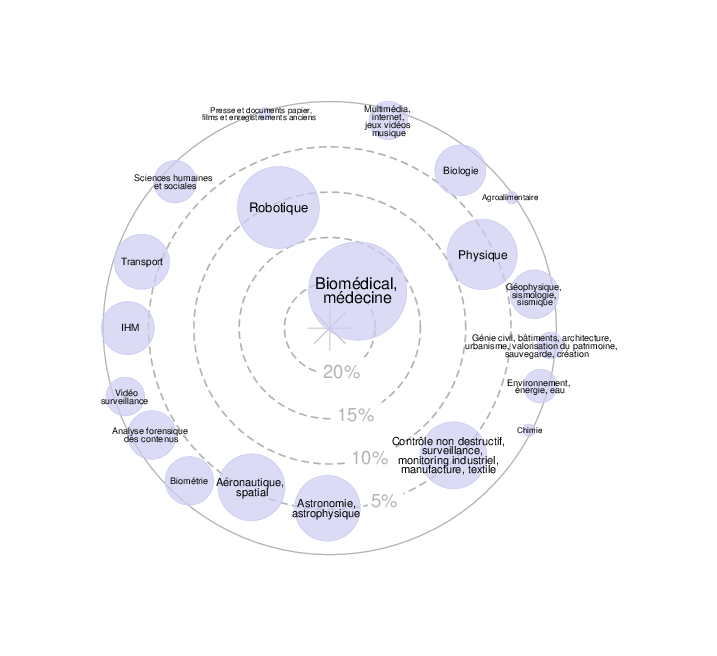
Expertises du GdR - cartographie par Axes - 19/09/2025![]() Expertises du GdR - cartographie par mots-clés applicatifs - 19/09/2025
Expertises du GdR - cartographie par mots-clés applicatifs - 19/09/2025