Réunion
VLMs unboxed: Architectures, Recent Advancements and Applications
Axes scientifiques :
- Fusion, multimodalité , réseaux de capteurs, traitement multicanal
Organisateurs :
- - Dino Ienco (INRIA - UCA)
- - Diego Marcos (INRIA - UCA)
- - Roberto Interdonato (LIRMM)
Nous vous rappelons que, afin de garantir l'accès de tous les inscrits aux salles de réunion, l'inscription aux réunions est gratuite mais obligatoire.
Inscriptions
16 personnes membres du GdR IASIS, et 25 personnes non membres du GdR, sont inscrits à cette réunion.
Capacité de la salle : 60 personnes. 19 Places restantes
Annonce
Vision-Language Models (VLMs) have undergone particularly rapid development in recent years, driven by joint progress in transformer-based architectures, self-supervised learning methods, and the growing availability of large-scale multimodal datasets. Capable of jointly processing visual and textual information, these models open new perspectives for a wide range of tasks: zero-shot discrimination, visual question answering (VQA), cross-modal retrieval, text-guided image generation, and complex multimodal reasoning.
Beyond generic architectures trained on massive, heterogeneous data, the community is also increasingly interested in specializing these models to specific application domains (medical imaging, remote sensing, cultural heritage, robotics, etc.) through post-training, as well as in the questions of robustness, interpretability, bias, and computational cost that accompany their deployment.
This thematic day aims to bring together the French community working on VLMs, through theoretical, methodological, or applied contributions, in order to take stock of the state of the art, share recent advances, and identify the scientific challenges ahead. It falls within the thematic axes of Machine Learning / Computer Vision / Natural Language Processing.
Objectives of the day
- Present the theoretical foundations and current architectures of vision-language models
- Provide an overview of recent advances (pretraining, multimodal alignment, foundation models, etc.)
- Discuss methods for specializing and adapting VLMs to specific application domains (fine-tuning, prompt-based adaptation, distillation, domain-specific data)
- Explore concrete applications across scientific and industrial domains
- Open a discussion on future research directions: evaluation, robustness, bias, computational efficiency, multimodal reasoning, and safety
Thematic sessions
- Foundations and architectures of VLMs: multimodal foundation models, image-text alignment mechanisms, contrastive learning, recent architectures
- Recent advances: new models, benchmarks, emerging capabilities (reasoning, compositionality, few-shot learning)
- Specialization and domain adaptation: fine-tuning, lightweight parametric adaptation (LoRA, adapters), domain-specific data, business and operational constraints, knowledge distillation
- Applications: medical imaging, remote sensing, robotics, cultural heritage, document analysis/OCR, video, etc.
- Limitations, evaluation, and perspectives: bias, hallucinations, interpretability, energy cost, evaluation protocols, open research directions
Invited speakers
- Vicky Kalogeiton (École Polytechnique) – Talk title: TBA
- Massimiliano Mancini (University of Trento, Italy) – Talk title: TBA
Practical information
The day will take place on December 8, 2026 at Université Paris Cité (Salle du conseil, 7th floor, 45 rue des Saints-Pères, 75006 Paris). The meeting will also be accessible remotely, but registration is mandatory.
Format
- Invited talks
- Short talks (selected contributions via the call for contributions)
Target audience
Researchers, faculty, PhD students, and postdocs, working on computer vision, natural language processing, and multimodal learning, as well as application-oriented communities interested in using VLMs in their own domain.
Call for contributions
Those wishing to present their work are invited to submit a title and an abstract (one page maximum) to dino.ienco@inria.fr by October 31, 2026 with the following subject: “GDR IASIS – VLMs Unboxed event – contribution“
Contributions from early-career researchers are particularly encouraged.
Requests for mission funding must reach the GdR administrator before November 18, 2026.
Organizing committee
- Stephan Alaniz (Télécom Paris),
- Dino Ienco (INRAE),
- Diego Marcos (Inria),
- Roberto Interdonato (CIRAD)
Programme
TBD
-

![]() Expertises du GdR - cartographie par Axes - 19/09/2025
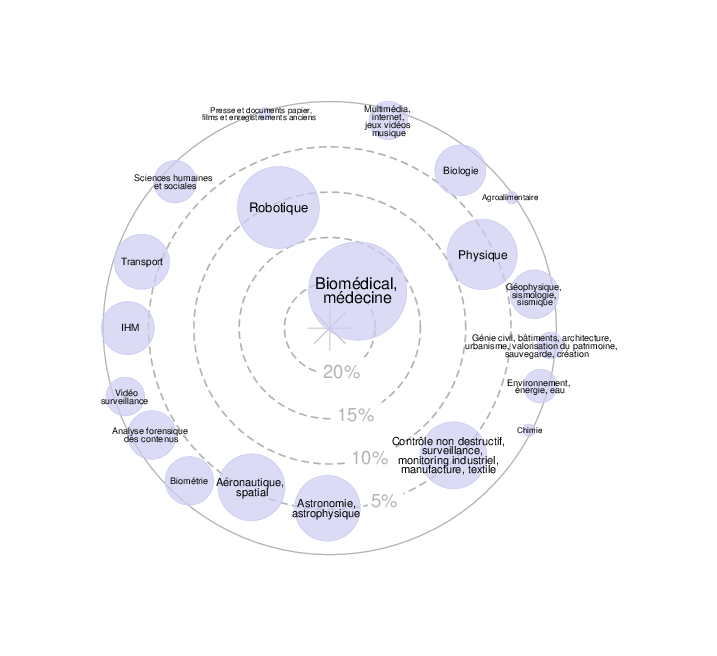
Expertises du GdR - cartographie par Axes - 19/09/2025![]() Expertises du GdR - cartographie par mots-clés applicatifs - 19/09/2025
Expertises du GdR - cartographie par mots-clés applicatifs - 19/09/2025