Réunion
Perception et cognition auditive
Axes scientifiques :
- Audio, Vision et Perception
Organisateurs :
Nous vous rappelons que, afin de garantir l'accès de tous les inscrits aux salles de réunion, l'inscription aux réunions est gratuite mais obligatoire.
La réunion sera également accessible en distanciel mais l'inscription est obligatoire
Inscriptions
15 personnes membres du GdR IASIS, et 19 personnes non membres du GdR, sont inscrits à cette réunion.
Capacité de la salle : 68 personnes. Nombre d'inscrits en présentiel : 32 ; Nombre d'inscrits en distanciel : 2
36 Places restantes
Annonce
Les demandes de prise en charge de mission par le GdR, sont à formuler avant le 4 novembre.
Dans le cadre de l’axe « Audio, Vision, Perception » du GdR IASIS, nous organisons une journée d’études dédiée à la perception et la cognition auditive. La journée se tiendra le Jeudi 19 Novembre 2026 à l’Ircam, à Paris.
L’audition est une énigme pour les sciences biologiques et médicales, notamment la physiologie, les neurosciences et la psychologie cognitive. Historiquement, les protocoles expérimentaux sur l’audition se sont appuyés sur la conception d’instruments scientifiques dédiés, notamment pour la synthèse et la transformation des stimuli sonores. Aujourd’hui, à l’ère des données massives et du calcul à haute performance, ces protocoles font appel à des technologies numériques toujours plus sophistiquées. D’où de nouveaux enjeux de recherche pour le traitement du signal ; et ce, non seulement pour les signaux audionumériques, mais aussi en multimodalité avec les signaux électrophysiologiques (EEG, MEG, IRMf, ECoG). Côté méthodes, on retrouve les méthodes classiques de l’analyse temps-fréquence, mais aussi celles, plus récentes, de l’apprentissage profond. Côté applications, les thématiques générales du codage perceptif et de la séparation de sources sont à l’ordre du jour, ainsi que des thématiques plus particulières concernant les aides techniques pour les personnes en situation de handicap ou de perte d’autonomie.
Dans ce contexte, l’objectif de cette journée est de dresser un panorama des recherches en cours sur la perception et la cognition auditive, abordées depuis le point de vue du traitement du signal. Nous accueillons des spécialistes de tous les sous-domaines des sciences de l’audition, depuis leurs racines neurophysiologiques jusqu’à ses ramifications psychologiques, esthétiques, linguistiques et sociales. De plus, le périmètre de la journée inclut non seulement les modèles d’écoute artificielle (machine listening) mais aussi toutes sortes de modèles computationnels informés par des connaissances sur l’audition. Enfin, nous voulons faire de cette journée un temps de partage entre, d’une part, l’innovation technologique en audio et, d’autre part, certaines questions ouvertes en perception et cognition auditive, telles que l’attention, la familiarité et l’anticipation.
Si vous souhaitez participer à la session poster, merci d’écrire dès que possible à Vincent Lostanlen : vincent.lostanlen (@) ls2n.fr. En préparation de la journée, il vous sera demandé un titre ainsi qu’un « audiocarnet » : c’est-à-dire, un fichier audio d’une minute environ donnant à entendre les sons sur lesquels porte votre poster. Pour des exemples d’audiocarnets déjà parus, voir : https://hal.science/AUDIOCARNET
Orateur.ice.s invité(e)s :
- Giorgia Cantisani (Ircam, STMS)
- Henkjan Honing (Université d’Amsterdam)
Organisateurs :
- Thomas Hélie (STMS, IRCAM)
- Mathieu Lagrange (LS2N, CNRS)
- Vincent Lostanlen (LS2N, CNRS)
Programme
09:00 Accueil (Café)
10:00 Introduction
10:15 Henkjan Honing (University of Amsterdam): Musical Animals. Are we? Can there be?
11:15 Etienne Thoret (CNRS, Institut de Neurosciences de la Timone): Beyond Fixed Filterbanks; Adaptive Signal Analysis for Auditory Modelling
12:00 Repas
14:00 Giorgia Cantisani (CNRS, Ircam): From sound structure to neural representations: Investigating the shared neural processing of music and speech with continuous stimul
14:45 Ugo Boscain (CNRS, Sorbonne Université): A Cochlea-Inspired Time-Frequency Representation and the Emergence of Subharmonics
15:30 Félicie Levinton (ENS Paris): Sensorimotor learning in ferret auditory cortex
16:15 Présentation brève des posters en salle
16:45 Posters et café
17:30 Clôture
Résumés des contributions
Ugo Boscain (CNRS, Sorbonne Université): A Cochlea-Inspired Time-Frequency Representation and the Emergence of Subharmonics
We introduce a simple mathematical model of the cochlea in which the basilar membrane is represented as a family of damped vibrating strings. Assuming that the information transmitted to the auditory cortex is related to the energy stored in these strings leads naturally to a cochlea-inspired time-frequency representation of sound. Unlike the classical spectrogram, this representation is causal and uses frequency-dependent time windows.
A remarkable consequence of the model is the spontaneous emergence of subharmonics. Higher vibration modes of the strings make an input frequency F activate cochlear regions associated with frequencies close to F/n, providing a simple mechanical explanation for the perception of the subharmonic series. I will discuss this phenomenon and its relation to a centuries-old question in musical acoustics.
Ugo Boscain is a CNRS Directeur de Recherche at the Laboratoire Jacques-Louis Lions, Sorbonne Université, and a member of the Inria CAGE team. His research has moved across geometric control theory, sub-Riemannian geometry, quantum control, and more recently mathematical models of auditory perception. A recurring theme in his work is the use of relatively simple geometric and dynamical models to uncover structure in complex physical and biological phenomena.
Giorgia Cantisani (CNRS, Ircam): From sound structure to neural representations: Investigating the shared neural processing of music and speech with continuous stimuli
Decades of research have shed light on the neural architecture of auditory processing through well-controlled experiments and discrete stimuli. But to what extent do these findings generalize to natural conditions such as attending to a concert or having a conversation? In music and speech, units of interest are not disconnected events, but are embedded within continuous, complex structures. In this presentation, I will talk about my work on music perception, with a particular focus on how the brain processes music compared to speech under naturalistic conditions. I will discuss how data-driven modeling can be used in this context to link continuous sound properties to multivariate neural activity, allowing us to probe underlying cog-neural processes that are otherwise hard to access, as they operate on the natural unfolding of musical and linguistic structures over time (e.g., predictive mechanisms) and are modulated by complex internal states (e.g., attention). This, however, requires computational models that can mimic human listening and the expectations listeners form about naturally occurring sound structures. I will discuss how such models can then be used to probe predictive processing during natural music listening and to investigate the interaction between lyrics and tunes in song. Thanks to this framework, we could probe signatures of shared and distinct neural processing of music and speech, as well as how factors such as attention, structure, and context shape their representations in the brain.
Giorgia Cantisani is a CNRS researcher working at the intersection of auditory neuroscience and machine learning. She obtained her PhD from Télécom Paris, where she investigated brain data decoding for music-related brain-computer interfaces. Since then, she has worked at École Normale Supérieure and now at IRCAM on how the brain processes complex sounds using electrophysiology and computational modeling. Her research focuses in particular on predictive processes and sensorimotor interactions underlying both music and speech perception.
Prof. Em. Dr Henkjan Honing (University of Amsterdam): Musical Animals. Are we? Can there be?
Recent interdisciplinary advances have transformed the study of the evolution of music. Rather than treating music as a cultural artifact, current research targets musicality — the biological capacity enabling humans to perceive, produce, and enjoy structured sound. Evidence from observations of infants, cross-cultural studies, and neuroscience shows that humans possess innate predispositions for rhythm, pitch, and temporal expectation that arise independently of training. Comparative studies have revealed that components of musicality have distinct evolutionary histories: primate research supports gradual development of rhythmic and audiomotor integration, while convergent traits in vocal-learning species highlight shared biological constraints. Neuropsychological and developmental findings have further shown that musicality is not reducible to language, drawing instead on perceptual, motor, and affective systems that likely predate speech. Collectively, these insights establish musicality as a fundamental cognitive capacity and provide a robust framework for investigating how its components evolved, how they function across species, and why music is central to human life.
Henkjan Honing (born 1959 in Hilversum) is a Dutch researcher. He is professor emeritus of Music Cognition at the Faculty of Science of the University of Amsterdam.[1] He conducts his research under the auspices of the Institute for Logic, Language and Computation, and the University of Amsterdam's Brain and Cognition center.
Felicie Levinton (ENS Paris): Sensorimotor learning in ferret auditory cortex
Many natural behaviors, from vocalizing to playing music, depend on a continuously varying relationship between movement and its sensory consequences, demanding fine-grained rather than all-or-none predictions. How the auditory cortex encodes and combines such graded acoustic information against similarly graded kinematics, and how it then anticipates the sounds that our movements will produce, remains unknown. We recorded from ferret primary auditory cortex while its head-direction controlled the frequency of an ongoing tone with milliseconds latency without a specific task. We then compared recordings during closed-loop blocks against acoustically matched open-loop blocks over the duration of repeated sessions. We found that auditory responses to self-generated sounds became more suppressed with extended experience, in proportion to elevated movement-related activity from motor cells carrying kinematic signals. Sensorimotor units showed anticipatory activity just prior to head motion whose magnitude scaled with the animal's distance from the head-direction that would have generated the auditory unit's best frequency response. This continuous mapping of direction-to-frequency persisted after the end of the sensorimotor coupling and generally became more focused with extended closed-loop exposure. Functional coupling with premotor cortex also strengthened in parallel. The auditory cortex therefore rapidly acquires by implicit exposure a persistent continuous forward mapping from the motor state to the expected sounds, whose motor input may be conveyed by premotor cortex.
Félicie Levinton is a PhD student at the ENS under the supervision of Yves Boubenec and Shihab Shamma, and is a trained *Ponts et Chaussées* engineer.
Etienne Thoret (CNRS, Institut de Neurosciences de la Timone): Beyond Fixed Filterbanks; Adaptive Signal Analysis for Auditory Modelling
Auditory models commonly describe sound through pre-defined filterbanks and modulation channels. While powerful and interpretable, these representations impose a fixed time-frequency geometry on signals whose structure is non-stationary, nonlinear, and hierarchical. In this talk, we will present a signal-driven approach to auditory modelling based on empirical mode decomposition (EMD), and the Holo-Hilbert spectrum.
This approach builds on our previous work on cascaded envelope interpolation, an EMD-inspired model of cochlear processing. Instead of assuming a fixed bank of frequency-selective filters, the model derives its modes from the extrema and envelopes of each incoming sound. We showed that this adaptive decomposition captures central properties expected of cochlear processing: its equivalent filter bandwidths are consistent with established cochlear frequency-selectivity laws, while its nonlinear behaviour accounts for virtual pitches and combination tones. These findings suggest that envelope interpolation offers a unified, data-driven computational account of both spectral selectivity and nonlinear auditory phenomena.
We will then extend this framework to nested amplitude modulations. Using controlled modulated sounds and modulation-masking paradigms, we will ask when a Holo-Hilbert analysis can distinguish one modulation from two, and compare these results with psychoacoustic findings on modulation filterbanks, asking what they reveal about the interaction between carrier structure and temporal envelopes. We will conclude by outlining current perspectives of applications to audio representations and neural encoding during naturalistic listening. The research described in this talk is a joint work with Solvi Ystad and Richard Kronland-Martinet.
Etienne Thoret is a CNRS research scientist at the Institut de Neurosciences de la Timone, Aix-Marseille University, France. His research combines auditory perception, acoustics, machine learning, and neuroscience to understand how sound structure supports perception and cognition. He develops interpretable and data-driven models of auditory representations, with applications to timbre, voice, natural soundscapes, and brain responses to sound.
-

![]() Expertises du GdR - cartographie par Axes - 19/09/2025
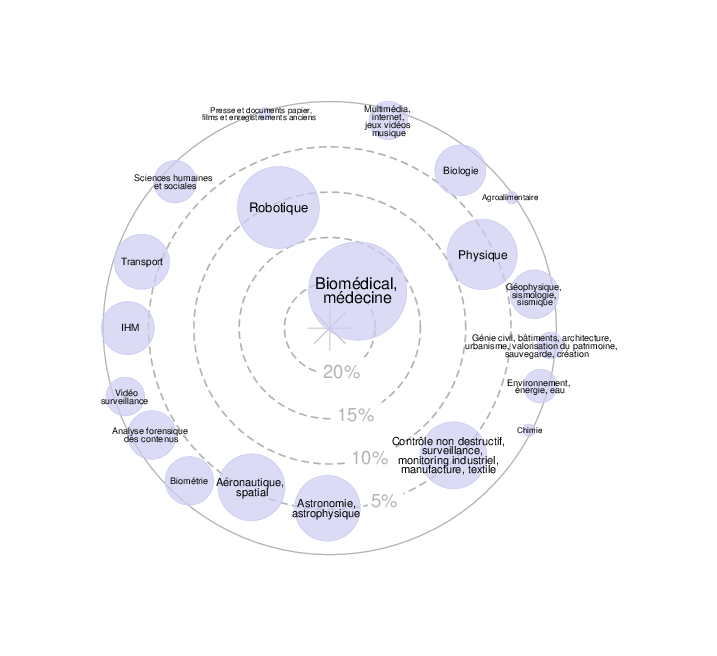
Expertises du GdR - cartographie par Axes - 19/09/2025![]() Expertises du GdR - cartographie par mots-clés applicatifs - 19/09/2025
Expertises du GdR - cartographie par mots-clés applicatifs - 19/09/2025