Réunion
Geometry and time-series processing
Axes scientifiques :
- Théorie et méthodes
Organisateurs :
- - Samy Labsir (ISAE - SCANR)
- - Laurent Oudre (Centre Borelli)
Nous vous rappelons que, afin de garantir l'accès de tous les inscrits aux salles de réunion, l'inscription aux réunions est gratuite mais obligatoire.
Inscriptions
22 personnes membres du GdR IASIS, et 52 personnes non membres du GdR, sont inscrits à cette réunion.
Capacité de la salle : 75 personnes. 1 Places restantes
Inscriptions closes pour cette journée
Annonce
L’ENS Saclay n’étant pas en mesure de garantir l’accès à ses locaux le 2 novembre, la journée se tiendra à Paris, 13 ème arrondissement – MAS, 10-18 rue des Terres au Curé.
In many signal processing and time series applications (navigation, motion analysis, sensor networks, etc.), measured data evolve in structured, non-necessarily Euclidean spaces. Over the past few years, a new research trend has emerged, incorporating these geometric constraints (Lie groups, Riemannian manifolds, etc.) into data processing methods (change-point detection, filtering, etc.). In parallel, tools from algebraic geometry and topology (signature theory, topological data analysis) have shed new light on time series analysis. The purpose of this scientific workshop is to present the latest advances regarding the links between signal processing and geometry (in a broad sense).
The topics include (not limited)
- Signal processing on manifolds
- Change-point detection on non-Euclidean space
- Signature theory and rough path
- Topological data analysis (TDA)
- Statistical learning on geometric spaces
- Analysis of structured time series
Organizers
- Samy Labsir (IPSA/TéSA–ISAE-SUPAERO)
- Laurent Oudre (Centre Borelli, ENS Paris-Saclay)
- Hugo Henneuse (Université Evry Paris-Saclay)
Résumés des contributions
Invited speakers
Karim Dahia (ONERA) Monte Carlo methods on Lie groups: application to Navigation. This presentation provides an overview of Monte Carlo methods for Bayesian state estimation, with a focus on extending them to systems that evolve on Lie groups. First, we introduce the probabilistic framework underlying Bayesian filtering, and discuss the challenges associated with nonlinear and non-Gaussian estimation problems. We then present the two main types of Monte Carlo approach: particle filtering and Sequential Markov chain Monte Carlo (MCMC) methods. The second part of the presentation focuses on state estimation when the state space is described by a Lie group. We discuss how particle filtering can be formulated directly on Lie groups, and how Sequential MCMC methods can be adapted to exploit this structure. These approaches provide flexible tools for representing and propagating complex probability distributions while respecting the geometry of the state space.Finally, we illustrate the proposed methods through navigation applications, in which position, velocity, orientation naturally lead to nonlinear estimation problems and, in many cases, to Lie group representations.
Fréderic Chazal (INRIA Saclay) A Topological Approach for Anomaly Detection in Complex Time-Series Data The aim of this talk is to present a novel method based on Topological Data Analysis (TDA) for detecting structural anomalies in complex data sequences. We will focus on the problem of identifying changes in the global dependency structure between channels of multivariate time series, represented as a weighted dynamic graph. This work is a joint collaboration with Clément Levrard (University of Rennes) and Martin Royer (IRT SystemX).
Marianne Clausel (CRAN/University of Lorraine) Mean and PGA for time series : the signature method answer! Multivariate time series (MTS) are ubiquituous in many fields as finance, environment or geosciences... In this talk we shall present a tool which is a analoguous of moments for MTS : the iterated integral signature. The two main contributions of this talk are related to an extension of mean and PCA to signatures of MTS, based on the lie group properties of the signature space. We illustrate on simulated and real data the effectiveness of our approach, compared to previous versions of PCA.
Contributed talks
Pierre-Olivier Amblard (GIPSA-lab)
Geometric Phase in Multivariate Complex Signals The notion of instantaneous phase in multivariate signal theory remains somewhat ambiguous. Building upon the pioneering work of Pancharatnam, we introduce a rigorous definition of phase that naturally reduces to the classical notion in the scalar case. This definition is also consistent with the framework developed by Lilly during the 2010s for the representation of multivariate amplitude- and phase-modulated signals. Using a differential-geometric approach based on principal fiber bundles, we show that the instantaneous phase can be decomposed into the sum of two components: a dynamic phase, which coincides with the conventional phase in the one-dimensional case, and a phase of intrinsically geometric nature, which appears only in dimensions two and higher. This latter component is referred to as the geometric phase. We illustrate the connection between this geometric phase and polarization in the context of bivariate and trivariate time series. We then describe how this phase can be estimated and provide several examples highlighting its behavior, together with potential implications for the analysis of nonstationary signals and array signal processing.
Kinan Abbas (ENS de Lyon)
Wavelet-Based Demixing for Multivariate Self-Similar Time Series Multivariate self-similarity provides a natural framework for describing correlated time series governed by a continuum of
temporal scales. Scale-free and self-similar dynamics arise in a wide range of applications, including biomedical signals, brain activity, and other complex time series . Fractional Brownian motion is a classical model for such dynamics [4], and wavelet methods provide a natural multiscale framework for estimating its scaling properties [5, 6]. Existing multivariate approaches primarily estimate the scaling exponents, while the correlation and mixing structures linking the latent components remain only partially identified.
Building on our initial wavelet-based demixing formulation, we introduce a framework for the full identification of multivariate fractional Brownian motion, jointly estimating its scaling exponents, correlation matrix, and mixing matrix. We apply a multivariate discrete wavelet transform and compute the wavelet covariance matrix at each scale. These covariance matrices provide a multiscale representation of the dependence structure and of the scaling behavior of the observed process. The estimation problem is formulated as a joint optimization based on three criteria: an approximate Gaussian maximum-likelihood criterion, a log-Euclidean criterion using matrix logarithms, and an affine-invariant Riemannian criterion for symmetric positive-definite matrices. Monte Carlo experiments show that the proposed method improves the estimation of the mixing matrix and model parameters while reducing computation time. The results confirm the effectiveness of the wavelet-based demixing approach for multivariate time series.
Guillem Rigaill (INRAE)
Online Multivariate Changepoint Detection: Leveraging Links With Computational Geometry
The increasing volume of data streams poses significant computational challenges for detecting changepoints online. Likelihood-based methods are effective, but a naive sequential implementation becomes impractical online due to high computational costs. We develop an online algorithm that exactly calculates the likelihood ratio test for a single changepoint in p-dimensional data streams by leveraging a fascinating connection with computational geometry. This connection straightforwardly allows us to exactly recover sparse likelihood ratio statistics: that is assuming only a subset of the dimensions are changing. Our algorithm is straightforward, fast, and apparently quasi-linear. The algorithms is computationally impractical when p is larger than 5, and we provide an approximate algorithm suitable for such p which is O(nplog(n)p~+1), for some user-specified p~≤5. We derive statistical guarantees for the proposed procedures in the Gaussian case, and confirm the good computational and statistical performance, and usefulness, of the algorithms on both empirical data and NBA data.
Arthur Pellegrino (ENS-PSL)
Geometry-aware similarity metrics for neural representations on Riemannian and statistical manifolds
Similarity metrics such as centered kernel alignment (CKA) are widely used to compare therepresentational geometries used by different neural networks to solve the same task. Yet, because existing methods compare the extrinsic geometry of neural representations in state space, rather than their intrinsic geometry, they may fail to capture subtle yet crucial distinctions between fundamentally different computations performed by neural networks. Here, I will present metric similarity analysis (MSA), a novel method which leverages tools from Riemannian geometry to compare the intrinsic geometry of representational manifolds. Within our mathematical framework, we derive several properties of MSA, including coordinate, scale and rotation invariances. We show that MSA can be used to i) disentangle neural computations of deep networks in kernel vs. feature learning regimes, ii) compare the computation-through-dynamics of recurrent neural networks vs. state-space models of biological time-series data, and iii) investigate the information geometry of statistical manifolds of diffusion models. Finally, I will present our more recent developments where, using tools from reproducing kernel Hilbert space theory, we prove an asymptotic equivalence within a class of similarity measures including MSA and CKA. Within this class, we show that MSA is a more natural characterisation of similarity for data on manifolds thanks to its geometric invariances.
Overall, we introduce a mathematically grounded and broadly applicable framework to understand the mechanisms behind the computations of different neural networks by contrasting their Riemannian geometries.
Erwann Le Pogam (L2S)
A second order neural network for domain adaptation on micro-Doppler signatures
Micro-Doppler signatures, the modulation of a radar echo induced by the motion of a target's moving parts, are a standard input for deep-learning-based automatic target recognition. In practice, however, trained networks are highly sensitive to distribution shifts caused by changing environmental conditions and class proportions at inference time. Domain adaptation (DA)
addresses this issue, but remains difficult in low-data regimes. We study whether second-order information can improve DA. Second-order neural networks are end-to-end architectures that aggregate features through covariance representations and operate on Riemannian manifolds, and they are known to yield features that generalize better. We propose two second-order architectures: one operating on the manifold of symmetric positive definite (SPD) matrices, and one based on the Siegel group. We benchmark both against several existing DA methods, evaluating how the choice of geometry affects the transferability of learned features under distribution shift
Alexey Lazarev (IMT Toulouse)
Geometry of latent spaces: curvature regularization and Riemannian clustering Latent spaces of autoencoders are an important tool for data visualization and for downstream tasks such as clustering. In this talk, I present two contributions at the intersection of geometry and machine learning: curvature regularization of autoencoder latent spaces, which incorporates a curvature-based term, together with auxiliary regularizers, into the autoencoder loss to improve their interpretability; and a Riemannian K-means algorithm designed for autoencoder latent spaces, which uses Riemannian distances computed from geodesics approximated via a Faber–Schauder basis.
Contributed posters
Myriam Frikha (INRIA Paris-Saclay)
TASC: Topology-Augmented Time Series Classification Improving Accuracy and Generalization via Persistent Homology
Stathis Delivorias (UMR IPSIM, Montpellier)
Intercept curves as topological descriptors of branching networks
Arnaud Liehrmann (CQSB, Sorbonne Université)
Papillon: pruning dynamic programming for changepoint detection by comparing means
Liam Kelley (Télécom Paris)
Direction-Aware Ambisonic Speech Separation using Edge-Conditioned Graph Convolution
Frédéric Barbaresco (Thales)
Lie Group Statistics and Lie Group Machine Learning Based on Lie Groups Thermodynamics & Koszul-Souriau-Fisher Metric
Théau Blanchard (Université Paris Cité, INRIA)
A Finslerian Approach for Embedding Directed Data
Thibault Pautrel (L2S)
Projection-Based Differentially Private Federated Learning on Riemannian Manifolds
Julian Brandon (ENS)
The balance between feature learning and collapse in generative dynamical systems
Louie-David Desachy (INRIA Paris-Saclay)
Generative modeling of diffeomorphic deformations for anomaly detection
Clément Gazzino (CNES)
Circular Receiver Bias Estimation for Integer Ambiguity Resolution
-

![]() Expertises du GdR - cartographie par Axes - 19/09/2025
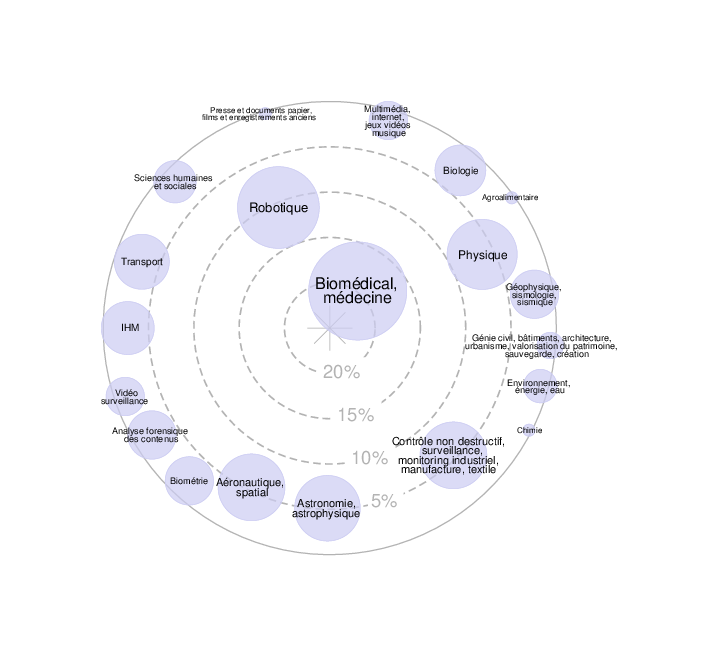
![]() Expertises du GdR - cartographie par mots-clés applicatifs - 19/09/2025