Scientific context
Synthetic Aperture Radar (SAR) imaging has become an essential remote-sensing modality to obtain high-resolution images in all-weather, day-and-night conditions (Soumekh, 1999). Modern SAR systems are increasingly used in applications such as Earth observation, surveillance, environmental monitoring, among others. As SAR technology evolves toward higher resolutions and more complex acquisition modes (e.g., multistatic, MIMO, InSAR, PolSAR), the need for robust methods to predict the accuracy and reliability of the system becomes fundamental.
The imaging system relies on the coherent processing of radar echoes collected along the platform trajectory to synthesize a large effective aperture and achieve fine cross-range resolution. It can be shown that the spatial positions of the sensor trajectory points map directly to the Fourier domain of the image, i.e. to the spatial frequency domain. Consequently, SAR image formation can be interpreted as the inversion of these Fourier-domain measurements, and the imaging process essentially reduces to computing an inverse Fourier transform of the collected data.
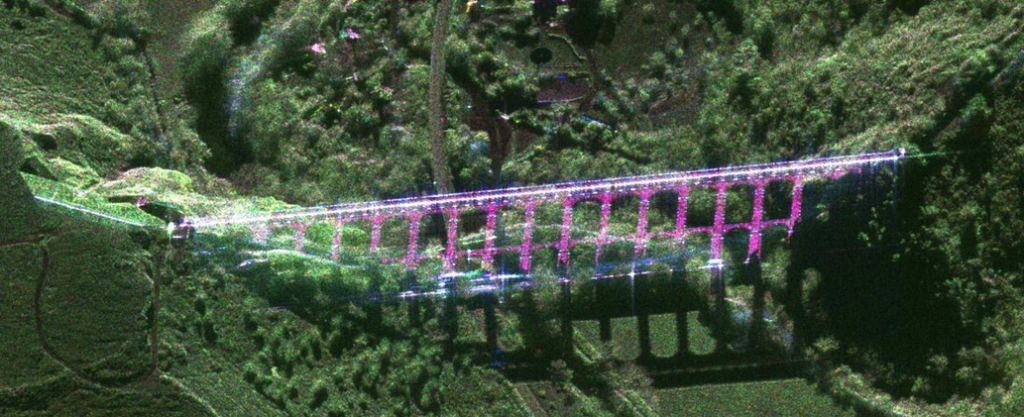
SETHI.
Proposed work
The objective of this internship is to investigate the imaging performance of a SAR system from a statistical estimation perspective. The approach relies on a parametric model that relates the measurements collected by the radar to a set of unknown parameters of interest. These parameters typically include the reflectivity of targets within the scene as well as their spatial locations, following the framework described in (Li and Stoica, 1996). The quality of estimation methods is generally characterized through metrics such as bias, variance, or mean-squared error (MSE). However, obtaining these quantities can be challenging—especially when no closed-form expression of the estimator exists, often requiring extensive and computationally demanding Monte Carlo simulations. As an alternative, we propose to study theoretical bounds on the variance or on the MSE, such as the Cramér–Rao Bound (Kay, 1993), to provide fundamental performance limits without resorting to exhaustive simulations.
- Study a relevant model for SAR imaging,
- Derive meaningful estimation accuracy indicators on the parameters of interest,
- Compare the proposed indicators with the performance of state-of-the-art estimation algorithms.
Results obtained may lead to formulate new tools and criteria for the design of synthetic aperture observation systems (González-Huici et al., 2018, Elbir et al., 2019, Wang et al., 2024). This work is expected to lead to the submission of a paper to a national or international conference in signal processing.
Expected profile and skills
This proposal is intended to Master level (M2 or equivalent) students in signal and/or image processing, with background in mathematics and statistics, and abilities in scientific programming and computing (e.g., Python, MATLAB). Applications from students in applied mathematics, electrical engineering, aerospace engineering, or any other related field with an interest in signal/image processing (estimation, detection, inversion, restoration, etc.) are also welcome.
Practical details
This 6-month internship is funded by the Institute of Aeronautics and Astronautics at Paris-Saclay University.
It will take place within the SICOIA team1 of SATIE laboratory, on the campus of ENS Paris-Saclay, in partnership with ONERA. Work will be jointly supervised by Lucien Bacharach (SATIE) and Joana Frontera Pons from ONERA, DEMR2.
Supervisors’ contact details:
- Lucien Bacharach, SATIE: firstname.name [at] ens-paris-saclay [dot] fr
- Joana Frontera Pons, ONERA/DEMR: firstname.name1_name2 [at] onera [dot] fr
Location: SATIE laboratory, campus of ENS Paris-Saclay, 4 avenue des Sciences, Gif-sur-Yvette, France.
Salary: approx. 625€/month
Dates:
- Reception of applications3: until mid-February 2025
- Duration: up to 6 months
- Starting date: before end of March 2025
References
- M. Soumekh, Synthetic Aperture Radar Signal Processing with MATLAB Algorithms. Wiley, 1999.↑
- J. Li and P. Stoica, « An adaptive filtering approach to spectral estimation and SAR imaging, » IEEE Transactions on Signal Processing, vol. 44, no. 6, pp. 1469–1484, Jun. 1996.↑
- S. M. Kay, Fundamentals of Statistical Signal Processing: Estimation Theory. Upper Saddle River, NJ, USA: Prentice-Hall, Inc., Mar. 1993, vol. 1.↑
- M. A. González-Huici, D. Mateos-Núñez, C. Greiff, and R. Simoni, « Constrained optimal design of automotive radar arrays using the Weiss-Weinstein bound, » in Proc. of IEEE International Conference on Microwaves for Intelligent Mobility (ICMIM). Munich, Germany: IEEE, Apr. 2018, pp. 1–4.↑
- A. M. Elbir, K. V. Mishra, and Y. C. Eldar, « Cognitive radar antenna selection via deep learning, » IET Radar, Sonar \& Navigation, vol. 13, no. 6, pp. 871–880, Jun. 2019.↑
- J. Wang, L. Bacharach, M. N. El Korso, and P. Larzabal, « A comparison of antenna placement criteria based on the Cramér-Rao and Barankin bounds for radio interferometer arrays, » Signal Processing, vol. 219, p. 109404, Jun. 2024.↑
Notes
1: Signaux multi-capteurs, Imagerie COmputationnelle et Incertitudes en Apprentissage, formerly known as « MOSS group » (Méthodes et outils pour les Signaux et les Systèmes). ↑
2: Département électromagnétisme et radar. ↑
3: Note: a delay of approx. 4 weeks is to be expected between the notification of application acceptance and the actual start of the work. ↑